
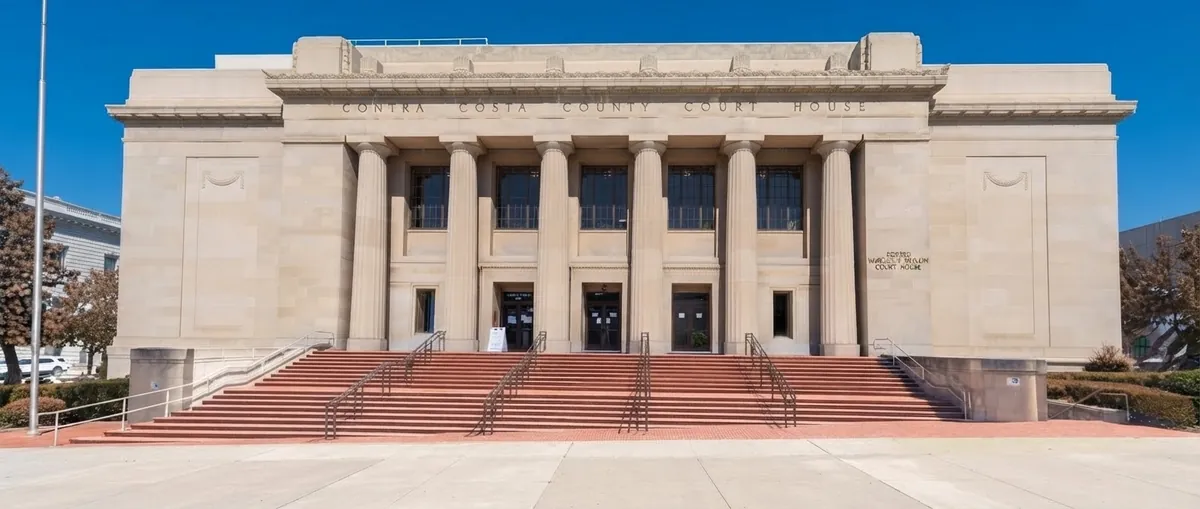
Court records in Contra Costa County, California, are maintained by the clerk of the Superior Court and can be accessed through online tools, official court portals, and the clerk's office. ContraCostaCourt.us can help you find publicly available court record information for Contra Costa County. You can also search records directly through the Superior Court of California, County of Contra Costa website, visit the clerk's office in person, or submit requests by mail. Additional government resources — including the county recorder, assessor, and state agencies — provide related public records.
Contra Costa Court System Overview
Contra Costa County is served by the Superior Court of California, County of Contra Costa, which is part of the California unified trial court system. California eliminated separate municipal and justice courts through unification, so the Superior Court handles all trial-level matters in the county. The court operates multiple locations throughout the county to serve its large population. The main courthouse — the A.F. Bray Courthouse — is located in Martinez, the county seat. For federal matters, Contra Costa County falls within the United States District Court for the Northern District of California.
A.F. Bray Courthouse
Courts Serving Contra Costa
Several courts at the state and federal level serve Contra Costa County residents:
Superior Court of California, County of Contra Costa
A.F. Bray Courthouse (Main — Criminal)
Court Records Office (Non-Criminal Cases)
George D. Carroll Courthouse
Arnason Justice Center
United States District Court — Northern District of California
United States Bankruptcy Court — Northern District of California
What Types of Cases Contra Costa Courts Hear
The Superior Court of Contra Costa County hears virtually all trial-level case types under California law:
- Criminal: Felonies, misdemeanors, and infractions
- Civil: Unlimited civil (over $25,000), limited civil ($25,000 or less), and small claims (up to $10,000 for individuals)
- Family law: Divorce, custody, child support, domestic violence restraining orders, paternity
- Probate: Decedent estates, guardianships, conservatorships, trust disputes
- Juvenile: Delinquency and dependency matters
- Traffic: Moving violations, parking citations, and DUI cases
The sections below explain how each category is handled.
District Court Cases in Contra Costa
Because California uses a unified Superior Court system rather than a separate district-and-magistrate structure, all trial-level cases are heard by Superior Court judges. Felony criminal cases typically begin with an arraignment, followed by a preliminary hearing where a judge determines whether sufficient evidence exists to hold the defendant for trial. If the case is held to answer, it proceeds to trial before a Superior Court judge. Civil cases seeking more than $25,000 in damages are classified as unlimited civil cases and are heard in the civil division. Appeals from Superior Court decisions go to the California Court of Appeal, First Appellate District, which covers Contra Costa County.
Magistrate Court Cases in Contra Costa
California does not have a separate magistrate court division at the state level. Instead, Superior Court judges and commissioners handle matters that would fall under magistrate jurisdiction in other states. This includes:
- Misdemeanors and infractions
- Felony arraignments and preliminary hearings
- Limited civil cases (claims of $25,000 or less)
- Small claims (up to $10,000 for individuals; $5,000 for businesses)
- Traffic violations and DUI arraignments
Commissioners and judges may be assigned to specific calendars — such as traffic, small claims, or unlawful detainer — depending on caseload volume at each courthouse location.
Family Law, Probate, and Juvenile Matters in Contra Costa
Family Law
The family law division handles divorce (dissolution of marriage), legal separation, child custody and visitation, child and spousal support, domestic violence restraining orders, paternity actions, and termination of parental rights. Family law cases are heard at the A.F. Bray Courthouse in Martinez. Certified copies of divorce decrees can only be obtained from the Superior Court where the divorce took place.
Probate
Probate matters — including decedent estates, guardianships, conservatorships, and trust proceedings — are handled by the probate division of the Superior Court. You can look up probate cases through the court's online case information portal.
Juvenile
Juvenile delinquency and dependency (child protective) cases are heard in the juvenile division. Juvenile court records are confidential under California law and are not available to the general public. Access is restricted to parties, their attorneys, and authorized agencies.
How Cases Move Through the Contra Costa Court System
- Filing / Initiation: A criminal case begins with a complaint or information filed by the District Attorney. Civil cases start with a complaint filed by the plaintiff. Family law and probate matters begin with a petition.
- Assignment: Cases are assigned to a judicial officer based on case type and courthouse location.
- Initial Hearing: Criminal defendants are arraigned and enter a plea. Civil cases proceed to a case management conference. Family law cases may have an initial status hearing or temporary orders hearing.
- Pre-Trial Phase: Parties exchange discovery, file motions, and may engage in settlement or plea negotiations. Criminal cases may include preliminary hearings for felonies.
- Trial or Resolution: Cases resolve through plea agreement, jury or bench trial verdict, settlement, or default judgment.
- Post-Judgment: Criminal cases move to sentencing. Civil judgments may be enforced or appealed. Appeals from Superior Court go to the California Court of Appeal, First Appellate District.
Court Administration, Local Rules, and Public Access in Contra Costa
The Superior Court of Contra Costa County is administered by the Presiding Judge and the Court Executive Officer. Local rules governing practice and procedure in Contra Costa County courts are published on the court's website. Statewide rules and forms are available through the California Courts website.
Public Access to Records
Under California law, most court records are presumed open to the public. Exceptions include sealed records, juvenile cases, certain family law filings, and records where a court has issued a confidentiality order. The California Public Records Act governs access to county government records; the county's public records page explains how to submit requests for non-court county records. For court-specific records, contact the clerk of the Superior Court directly.
Attending Hearings
Most hearings at the Contra Costa Superior Court are open to the public. Some proceedings may be available by remote appearance — check the court's website or contact the clerk's office at (925) 608-1000 for current remote-hearing procedures.
Court Records and Related Court Resources in Contra Costa
- Online case search: Use the court's public portal for civil, small claims, and probate cases. Criminal case index information is available through the criminal court records page, though minutes and documents require a formal request.
- Order files and records: To request copies of court documents or certified copies, visit the order a file and records page or the certified copies information page. Requests can also be submitted by mail through the civil court records office.
- County public records requests: For non-court county government records, submit a public records request or use the county's online request form.
- County Clerk-Recorder: The Contra Costa County Clerk-Recorder maintains property documents, vital records, and other recorded instruments.
- Property and tax records: The County Assessor provides property assessment data, and the Treasurer-Tax Collector handles property tax payments and records.
- Criminal history information: The California Department of Justice manages state-level criminal history records and background check requests.
- Inmate search: The California Incarcerated Records and Information Search (CIRIS) allows you to look up individuals in state prison custody through the California Department of Corrections and Rehabilitation.
- Sheriff's office: The Contra Costa County Sheriff's Department handles fingerprinting services and local law enforcement records.
- Court forms and self-help: The California Courts website provides statewide court forms, self-help guides, and step-by-step instructions for common case types.